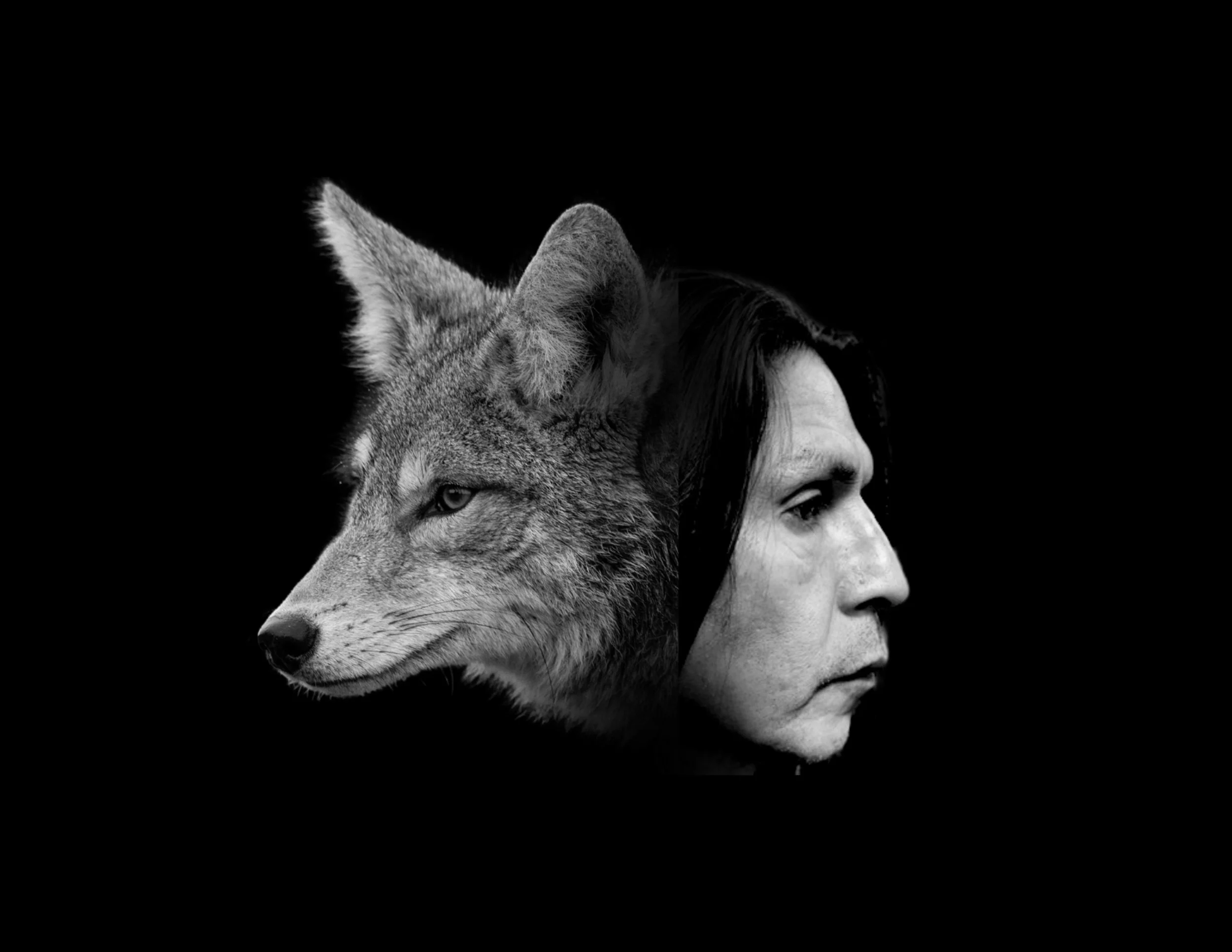
Coyote Walks Beside Him
This photograph of my brother beside the coyote emerges from my understanding of Ute story, land, spirit, and lived experience. Within Ute oral traditions, Coyote and Sinawav appear within a larger body of teachings concerning creation, relationships, behavior, consequence, and balance. Duncan (2000) describes Sinauf, Coyote, and Wolf as powerful animal-person beings whose stories became woven into Ute history and cultural understandings of relationships between human beings, animals, the spiritual world, and the land. Rather than viewing Coyote only as a trickster, I understand him as a relational teacher whose actions reveal lessons about hunger, desire, mistakes, consequence, survival, and responsibility.
In this photograph, Coyote stands beside my brother as a witness to a life shaped by addiction, love, grief, movement, and survival. I see parallels between the Coyote stories and the cycles surrounding substance use. Coyote often moves according to hunger, impulse, curiosity, or desire, and his choices lead him toward consequences from which another lesson emerges. Collections of Ute oral narratives preserve stories in which Coyote and Sinawav encounter hunger, competition, deception, mistakes, animals, and the consequences of their own actions (Givón, 2013). For me, these teachings create a culturally meaningful language for thinking about addiction without reducing my brother's life to addiction itself.
My interpretation also draws from Indigenous Storywork. Archibald (2008) explains that Indigenous stories carry teachings through relationships among storyteller, story, listener, community, spirit, and lived experience. Her principles of respect, responsibility, reciprocity, reverence, holism, interrelatedness, and synergy provide an ethical foundation for approaching stories as living knowledge rather than objects separated from the people who carry them. Through this understanding, the photograph becomes part of my own Indigenous Storywork. My brother, Coyote, memory, land, grief, and my relationship to him remain connected within the story.
Addiction, from this perspective, represents more than an individual behavior. In my work, it becomes connected to disruption, grief, disconnection, family memory, colonial histories, and the longing to return to balance. Coyote offers a language for understanding this movement. He becomes hungry, loses direction, experiences consequence, survives, and continues forward. His presence beside my brother therefore carries tension. He holds vulnerability and danger, yet he also carries endurance, adaptability, and the possibility of learning through lived experience.
I created this image as an act of witness, remembrance, and relationship. My brother remains more than the circumstances surrounding his addiction. He remains my relative, part of our family story, and part of the land and memories I continue to carry. Coyote allows me to hold these contradictions together. Through him, I speak about addiction without separating the person from kinship, spirit, land, or humanity. The image becomes a lesson in consequence and survival, while also raising a deeper question about how we find our way home after becoming disconnected from ourselves and those who love us.
Reference:
Archibald, J. (2008). Indigenous storywork: Educating the heart, mind, body, and spirit. UBC Press.
Duncan, C. (2000). The Northern Utes of Utah. In F. S. Cuch (Ed.), A history of Utah's American Indians (pp. 167–224). Utah State Division of Indian Affairs and Utah State Division of History.
Givón, T. (Ed.). (2013). Ute texts. John Benjamins Publishing Company.
Coyote Walks Beside Him, Valentina R. Sireech, 2024
Black-and-white digital print 34 X 26